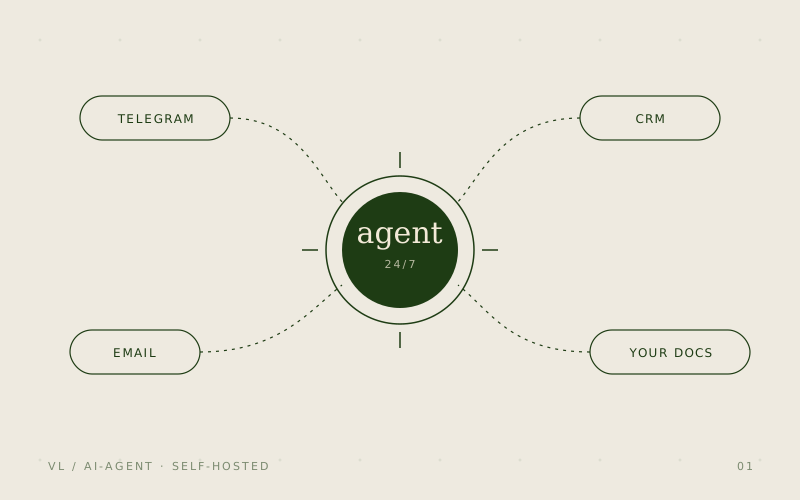
Dashboard, storefront and agent
A operations system built around how your business actually runs
A dashboard you log into, add to and look at. A storefront fed from the same data. And an agent that does the arithmetic, reconciles the numbers and answers questions in words instead of another spreadsheet.
The Problem
Sound familiar?
Records live in three spreadsheets, none of which agree, and only the person who maintains them knows which one is right
Working out the margin on a single item means manually combining cost, shipping, marketplace fees and returns
Warehouse stock, marketplace stock and the spreadsheet show three different numbers — and a customer tells you first
You have an ERP, but every change means a contractor, three weeks and an invoice, so the team keeps a parallel spreadsheet anyway
We get it
“We have seen this often enough: the business already works and makes money, but it is run out of a file nobody except one person dares to open.”
Our track record
We have built operations systems for clothing, supply and marketplace businesses — including one that replaced 25 hours of manual work a week. The code and the database stay yours.
How It Works
Three steps to get started
Map
We look at how you count today: spreadsheets, ERP, chat threads, a notebook. We find where the numbers diverge and why. You get an entity map and a list of what has to reconcile.
Build
We stand up a dashboard around your entities: products, orders, suppliers, money, staff. Existing data is migrated in. Roles and permissions from day one, not later.
Agent
We add the agent: it calculates cost and margin, reconciles stock between your warehouse and the marketplaces, sends reports to chat and answers questions in plain language.
Deliverables
What's included
Concrete deliverables. The $500 Digital Business Brain covers connecting your first systems; the full list below ships in a paid engagement — fixed quote after the discovery call.
Results
What you can expect
The cost of waiting
While the books live in a file, the business rests on one person and their memory. That works right up until the first holiday, resignation or crash — which is exactly when you find out what "we'll sort it out later" actually cost.
FAQ
Operations System — FAQ
We start with a $500 review: we connect your data and show what is already visible in it. After that, a fixed quote — typically 2–4 weeks of work. Running costs afterwards are hosting and AI model usage only, paid directly to the providers with no markup.
No, and it should not. The ERP stays the system of record for accounting. The dashboard covers what you keep parallel spreadsheets for anyway: live stock, margin and reconciliation. We read from the ERP through its exchange interface and never touch its core.
Yes. We deploy on your server or in your cloud, with your credentials. Source code and database are handed to you. No model is trained on your data — everything runs through APIs.
The system is built so new entities and reports can be added without a rewrite. Changes in the first month after launch are part of the project; after that, by agreement.
Related guides
An AI agent for 1C:Enterprise: what it can do, where it breaks, and how to deploy it safely
What AI agents genuinely handle on top of 1C — data Q&A, ad-hoc reports, routine operations, developer assistance — and the architecture that keeps the database safe: read-only roles, plan review before any write, a full audit log. Written in Russian for the market it serves.
English summaryA digital employee for marketplaces: an AI agent for Wildberries and Ozon sellers
A seller's morning is exports from two dashboards, spreadsheet merging and margin recalculation. The guide shows how an AI agent on top of the WB and Ozon APIs takes that routine over — and where automation stays fragile. Written in Russian, the language of both marketplaces.
English summaryAI tooling for 1C:Enterprise in Claude Code and OpenAI Codex
A survey of the 1C AI ecosystem: three dozen MCP servers, large Claude Code skill packs, the official BSL Language Server plugin and the Unica plugin for Codex. Written in Russian — the market it serves is Russian-speaking.
English summaryHow much does a custom AI agent cost in 2026? An honest breakdown
Market ranges for build and monthly run, the five drivers behind any quote, break-even math for no-code vs SaaS vs custom, and the hidden costs vendors leave out of proposals. Written by a team that builds agents — including the honest cases where you shouldn't buy one.
Read the guide